
Agricultural solar — NI
Big roofs. Big bills. Solar was made for farms.
Milking, cooling, ventilation, drying — farm loads run through daylight hours, and the shed roof above them is prime generating space. NI farms are some of the fastest-payback systems we install.
Glow Electric installs agricultural solar across Northern Ireland — dairy, poultry, grain and mixed farms. Three-phase systems designed around milking, cooling and ventilation loads, G99 connections with NIE Networks handled, NICEIC-certified. Free site survey and a payback figure built from your own bills.
 NICEIC Approved Contractor
 RECC registered
Single & three-phase — both handled
25-yr panel performance warranty
Why farms win
The maths is better in a farmyard.
Three things line up on a farm that rarely line up anywhere else.
-
Milking · cooling · drying
Daytime loads
Parlour washdown, milk cooling, fans, feeders and dryers all pull power while the panels produce it. High self-use makes payback quick.
-
Hedge the bill
Exposure to prices
Farms feel energy price swings harder than most businesses. Generating your own is the only hedge that also cuts your carbon numbers.
-
Big steel planes
Roof space for free
Sheds carry big, unshaded, well-pitched roofs — the cheapest solar real estate there is. No scaffolding a terraced street.
Farm types
Sized to the enterprise, not off a brochure.
- Dairy. Cooling and washdown are relentless daytime loads — the classic fast-payback farm install.
- Poultry. Ventilation, feeding and lighting run constantly — solar plus storage flattens the bill and covers welfare-critical loads.
- Grain and potato stores. Drying and chilled storage in the brightest months — generation and demand at their peaks together.
- Mixed yards. Workshops, pumps and houses fed from one array — we design around how your yard actually runs.
Backup matters on a farm — a power cut mid-milking is not a joke. Ask about battery backup while we're pricing the roof.
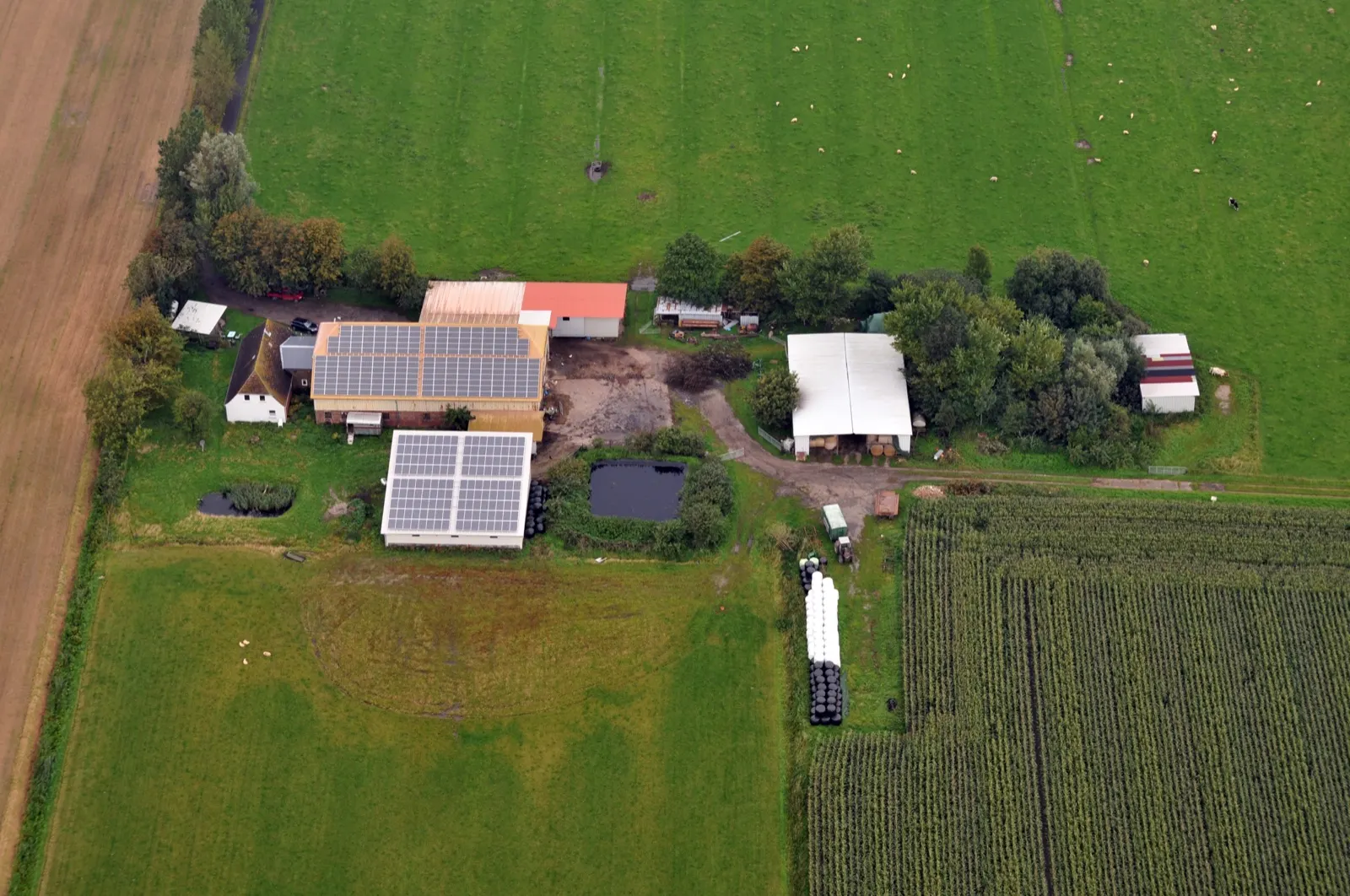
Farm by farm
Where solar earns its keep on NI farms.
Agricultural electricity use maps almost perfectly onto daylight — which is why farm solar pays back faster than nearly any other install we do.
Dairy
Milking parlours, bulk tank cooling and water heating run twice a day, every day. A shed-roof array offsets the morning milking directly, and a battery carries the evening one. Vacuum pumps and cooling are exactly the steady loads solar loves.
Poultry
Ventilation, feed lines, lighting and heating run continuously — poultry units are among the highest electricity users in NI agriculture. Big shed roofs mean the generation is sitting right above the load.
Pigs, beef & general
Feed preparation, slurry aeration, workshops, cold stores — every farm has a base load ticking over. We meter what you actually use before we design, so the system is sized on data, not brochure maths.
The technical bit
Three-phase, G99 and big roofs — our home ground.
Most working farms are on three-phase supplies, and most worthwhile farm systems sit above the G98 limit — which means a G99 application to NIE Networks before energisation. We design the system, prepare and chase the application, and balance generation across phases properly. Fibre-cement roofs, steel sheeting, ground mounts in a spare corner of a field: each gets the right fixing system, engineered for wind loading, not guessed.
- Full G99 application to NIE Networks handled for you
- Roof-integrity assessment before a single rail goes up
- Ground-mount options where sheds face the wrong way
- Export metering set up — surplus becomes income, not waste
Money
Grants come and go. The payback doesn't.
Right now there is one worth knowing about: Power NI's NISEP scheme funds 20% of a qualifying solar PV installation for businesses and farms, and the 2026/27 round is open — but the grant offer letter has to be in your hand before you order, and the money runs out. Other capital schemes open and close in tiers; we'll tell you honestly what's open when you enquire rather than dangle last year's scheme. What doesn't change: 0% VAT on the installation, capital allowances against farm profits, and daytime electricity you stop buying from the day it's commissioned. Most working-farm systems we survey model a payback in the four-to-seven-year range, with panels warranted for twenty-five.
Is there a grant for farm solar in Northern Ireland?
Yes, for businesses — unlike homes. Power NI administers the Northern Ireland Sustainable Energy Programme (NISEP), which funds 20% of qualifying installations across six technologies, solar PV among them, and the 2026/27 scheme is open. Funds are limited and allocated first come, first served, and you must hold the grant offer letter before you place the order — order first and the funding is lost. Tell us at survey and we will quote and programme the job around that sequence.
Is my shed roof suitable for solar panels?
Most modern steel-clad sheds are ideal — big unshaded planes with straightforward fixing. Older roofs get a structural once-over at survey. Fibre cement needs a bit more care, and we'll tell you honestly if a roof isn't worth panelling.
We're on three-phase. Is that a problem?
It's an advantage. We're electricians — single-phase, three-phase and everything on the yard is our day job. Three-phase supplies suit bigger arrays and bigger savings.
What size system does a farm need?
It depends on your loads — milking and cooling, ventilation fans, grain drying all have different shapes. We size from your bills and usage pattern so the array feeds the farm rather than the grid.
Where we install
Farm solar across Northern Ireland.
Based in Belfast, we install within about an hour and twenty of the city — covering most of Northern Ireland. Find local information for your area.
View all areasPut the shed roof to work.
A yard walk, a look at the bills, and a modelled system for your enterprise — free, and priced fixed if you go ahead.