
No, solar panels do not have to face south. East- and west-facing roofs can be worth considering in Northern Ireland. A north-facing roof needs a closer look at pitch, shading and cost. The useful question is how much your actual roof can generate, when you can use it and what the installation will cost.
Below we compare six directions using the same Belfast weather model, then explain what optimisers and modern LONGi and AIKO panels can—and cannot—change. This is a guide to choosing a layout, not a promise that every roof will achieve the figures shown.
Which direction is best for solar panels in Northern Ireland?
For the Belfast example below, south produces the most electricity over the year. South-east and south-west are close behind. East and west produce less annually, but that does not automatically make them poor investments. Usable roof area, installation cost and the amount of electricity used at home also matter.
Orientation means the direction the roof faces. Pitch means how steep it is. Two roofs pointing the same way can have different results because their pitches and shadows differ. We would not reject a roof—or promise a return—based on a compass direction alone.
Belfast performance comparison: south, east, west and north
We ran six calculations with the European Commission's PVGIS tool. Each uses 1 kWp of crystalline-silicon panels at 35° pitch, the same Belfast location and the same loss assumptions. Only direction changes. kWp is the panel system's rated capacity; kWh is the electricity it generates.
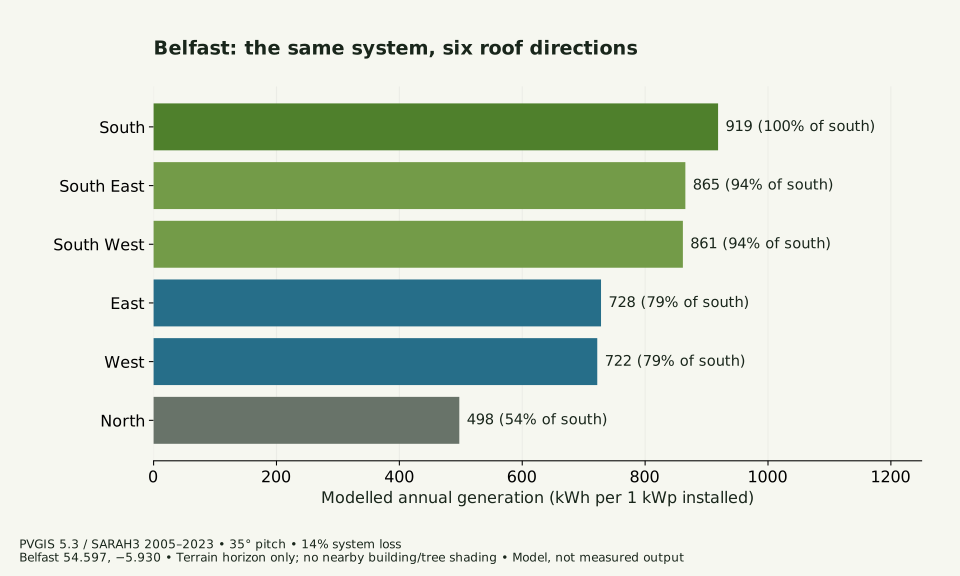
| Direction | kWh/year per 1 kWp | Relative to south |
|---|---|---|
| South | 919 | 100% |
| South-east | 865 | 94% |
| South-west | 861 | 94% |
| East | 728 | 79% |
| West | 722 | 79% |
| North | 498 | 54% |
In this model, east or west produces about 79% of the south-facing total. That is not a universal 21% penalty: change the pitch, location or shading and the comparison changes. A half-east, half-west system of the same total capacity would sit between the east and west results under these assumptions—not add both full-system totals together.
Model assumptions and limitations
PVGIS 5.3, Belfast 54.597° N, 5.930° W; SARAH3 radiation data, 2005–2023; generic crystalline silicon; 1 kWp; fixed 35° slope; 14% system-loss input. The mounting option is PVGIS “free-standing”, representing a ventilated rather than building-integrated installation. Terrain-horizon shading is included; nearby trees, chimneys and buildings are not. No battery, export limit, brand-specific shade response or household demand is modelled. Calculations retrieved 1 October 2026. Actual annual output varies with weather and the installation.
What happens in winter?
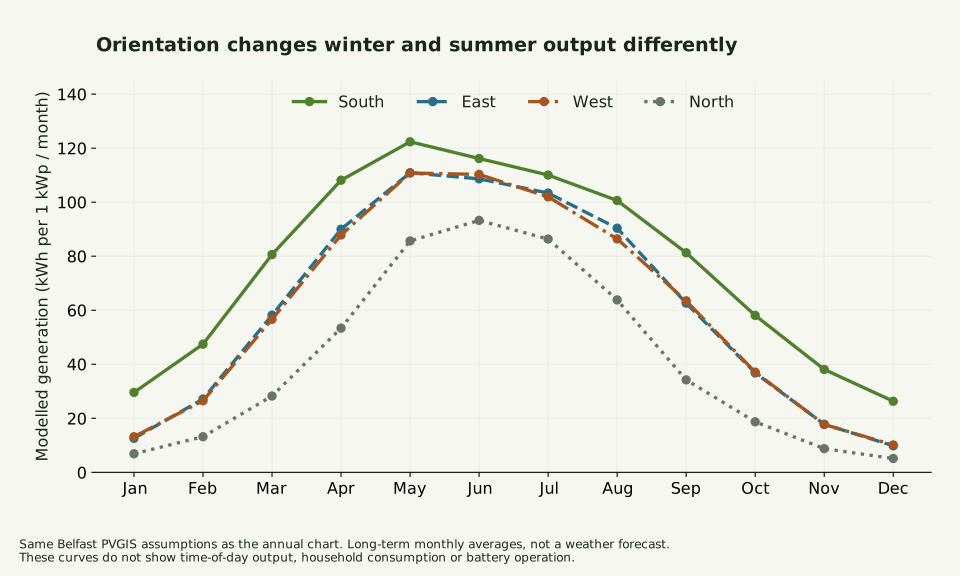
The annual total hides the seasonal difference. In this example, north-facing output is particularly weak in winter. A battery can move available electricity to another time; it cannot make up for sunlight that the roof never receives.
Can an east-west roof suit a household better?
East and west roofs receive direct sunshine at different times. Whether that helps your household depends on your daytime usage, any battery and flexible loads such as EV charging. More electricity generated and more money saved are different questions. A south-facing system with a suitable battery may still be the stronger option.
We compare generation with your usage rather than assuming everyone is out all day. Tell us when the house is occupied and when you charge the car. The monthly graphs above cannot establish your self-consumption or bill savings; that requires a separate demand model.
Do solar panels work on a north-facing roof?
The model shows that north-facing panels still generate, but considerably less at this pitch. We would examine roof slope, shade, available space and the extra installation cost before recommending that face. A shallow north-facing roof and a steep one are not equivalent. If the numbers do not justify using it, leaving that face empty is a valid design choice.
What does optimisation actually mean?
- Layout and inverter design: placing panels away from avoidable shadows and checking how different roof faces connect to the inverter's maximum power point tracking (MPPT) inputs.
- Panel-level electronics: DC optimisers or microinverters can reduce some mismatch losses. Suitability depends on the selected system and shading pattern; extra equipment is not automatically worthwhile.
- Technology inside the panel: cell design and bypass behaviour affect how a module responds to partial shade. This is different from fitting an electronic optimiser behind it.
None of these can restore sunlight blocked by a building or turn a north-facing roof into a south-facing one. The starting point is the roof and its shadows, then compatible equipment and a design that makes sense financially.
What do performance studies tell us?
A 2012 NREL shading test compared identical 8 kW arrays using a microinverter and a reference string inverter. Its weighted results showed gains of 3.7%, 7.8% and 12.3% under light, moderate and heavy shade respectively. Those are results for that equipment and test method—not a forecast for a modern Belfast installation and not a test of LONGi or AIKO panels. The useful lesson is that the shading scenario changes the benefit.
Where LONGi and AIKO panel technology fits
LONGi: HPBC 2.0 and partial shading
LONGi's Hi-MO X10 uses HPBC 2.0 back-contact technology. In LONGi's published account of CPVT testing, shading half of one cell caused average module power losses of 10.15%, compared with 36.48% for the tested TOPCon modules. That is a specific manufacturer-reported test comparison. It does not mean 70% more electricity over a year, and it does not describe a whole panel shaded by a neighbouring building.
AIKO: ABC and partial shading optimisation
AIKO's ABC stands for All Back Contact. Its technical explanation of partial shading optimisation describes how the cell design can limit the electrical effect of a locally shaded cell, allowing more of the unaffected cells to keep contributing. This is a feature of the panel, not a separate box fitted behind it. Check the exact module and generation being quoted: a brand name alone is not a specification.
Neither manufacturer's claim is included as a bonus in our PVGIS graphs. Those graphs use generic panels. For a quote, compare the actual modules' dimensions, power rating, warranty, inverter compatibility and behaviour under the shade on your roof. We confirm the equipment proposed for your job; mentioning a product here does not promise that every model is available.
How we assess your roof
Our east Belfast case study shows a PV*SOL design using several roof faces rather than one south-facing array. It is a separate, property-specific simulation, not proof that another house will achieve the same result.
For your assessment, tell us your town, electricity usage and any EV or battery plans. At survey we check the roof faces, pitch, nearby obstructions and electrical installation. See our solar panel installation service in Belfast and Northern Ireland for packages and the survey process, or our battery storage page if you already have panels.
Ask us to assess your roof. There is no need to know its exact compass bearing before getting in touch.
Questions people ask
Do solar panels have to face south in Northern Ireland?
No. East- and west-facing roofs can be suitable. Assess pitch, shading, usable area and electricity demand before deciding. In our Belfast example at 35 degrees, east and west produce about 79% of the annual south-facing output; that is a model result, not a universal rule.
Will optimisers fix a north-facing or shaded roof?
No. Compatible panel-level electronics can reduce some electrical mismatch losses, but cannot restore blocked sunlight or change the direction of a roof. The expected benefit needs to justify the cost for the particular installation.
Are AIKO and LONGi shading features the same as an optimiser?
No. The panel features discussed here concern cell-level behaviour within particular back-contact modules. A separate DC optimiser is an electronic device. The design and exact equipment determine whether additional electronics are appropriate.